
Iran offers 2-day Hormuz reopening on its terms as oil hits $117
Iran's foreign minister said Saturday that a plan worked out with Qatari mediators could reopen the Strait of Hormuz in two days, but only if the U.S. lifts sanctions, pulls back forces and frees Iran's frozen money. Oil closed Friday at its highest since April, and U.S. gas averages about $4.18 a gallon.
AI-assisted · US Brief desk · Sources listed below
What happened
Iranian Foreign Minister Abbas Araghchi told Al Jazeera on Saturday, Oct. 31, that talks with Qatari mediators had produced a plan to reopen the Strait of Hormuz within two days. "The Qatari side proposed shortening the implementation period of the Iranian proposal to five days. We have reached a proposal at this stage that reduces the implementation period to two days," he said. The narrow waterway between Iran and Oman carries a large share of the world's oil and gas shipments, and traffic through it has been disrupted since the U.S.-Iran war began on Feb. 28.
Why it matters
Oil prices have climbed on fears the war will flare up again after Tuesday's midterm elections. On Friday, Brent crude, the global benchmark, settled at $117.64 a barrel and U.S. crude at $104.12, both the highest since late April, Reuters reported. Brent rose 13.6% in October. The national average for regular gas was about $4.18 a gallon on Saturday, according to AAA. A real reopening would likely ease that pressure; a breakdown could push it higher.
More context
The catch is Iran's price. Araghchi said the conditions include lifting the sanctions imposed after the Islamabad memorandum (a U.S.-Iran deal from June that later collapsed), reducing U.S. forces in the region, restoring waivers that let countries buy Iranian oil, and releasing all of Iran's frozen money, including funds held in Qatar. He also wants recognition of shipping lanes Iran worked out with Oman, and the closing of other routes. Reopening the strait on those terms "paves the way for the resumption of negotiations with Washington," he said.
Araghchi called a letter from Vice President JD Vance "a positive step," but said Iran sees "no need to meet with the Americans at this stage." Al Jazeera's reporter in Tehran said there was "no remarkable flexibility in Iran's position." Iran's supreme leader, meanwhile, threatened an immediate response "without geographic limits" to any new attack, AP reported. As of publication, US Brief found no public White House response to the two-day plan.
What each side says it wants: Iran wants sanctions lifted, its money released, its oil waivers back and fewer U.S. forces nearby before it reopens the strait and returns to talks. The U.S., by Al Jazeera's account, wants the strait reopened, and U.S. media have reported that Washington wants nuclear talks to start right away, while Tehran wants them to wait until other steps are done. Each side wants the other's commitments carried out on the ground, not just promised on paper.
The strongest case for taking the offer seriously: Shrinking the timeline from five days to two, and Iran sending a delegation to Doha the day after Qatari mediators visited Tehran, are concrete signs that talks are moving. A fast reopening would cut a risk that has kept energy and shipping costs high for eight months.
The strongest case for skepticism: The conditions are largely the same ones Iran has set before, and they would require the U.S. to give up its main leverage first. The U.S. Treasury says its pressure campaign has worked: it reports Iran has loaded no oil onto ships since Aug. 25 and that Iran's currency, the rial, has fallen about 25% since late August, according to Iran International's account of the Treasury report. Critics of a deal argue that easing that pressure before Iran acts would reward it for closing the strait.
What's still unknown: whether the U.S. or Qatar has accepted the two-day plan or any of its conditions; how much frozen money is involved in total (Al Jazeera's reporter cited $6 billion held in Qatar alone); what "reducing U.S. forces" would mean in practice; and whether Iran's proposed Oman routes would be acceptable to other Gulf states and shipping companies.
7 listed sources
- Al Jazeera, "Iran FM says US outreach a 'positive step' as delegation in Qatar for talks," Oct. 31, 2026
- AP, Mideast news, Oct. 31, 2026
- Dawn, "New proposal shortens implementation of Iran's plan to open Hormuz to 2 days, Araghchi says," Oct. 31, 2026
- Tehran Times, "Araghchi: Iran has no plans for talks with US until its conditions are met," Oct. 31, 2026
- Iran International, "Hormuz can be reopened in to two days, Araghchi says," Oct. 31, 2026
- Iran International (citing Reuters), "Oil jumps 2% to six-month highs on Iran escalation fears," Oct. 31, 2026
- AAA Fuel Prices, national average, Oct. 31, 2026
References listed by US Brief; a source count is not a verification score.
Editorial sourcing notes
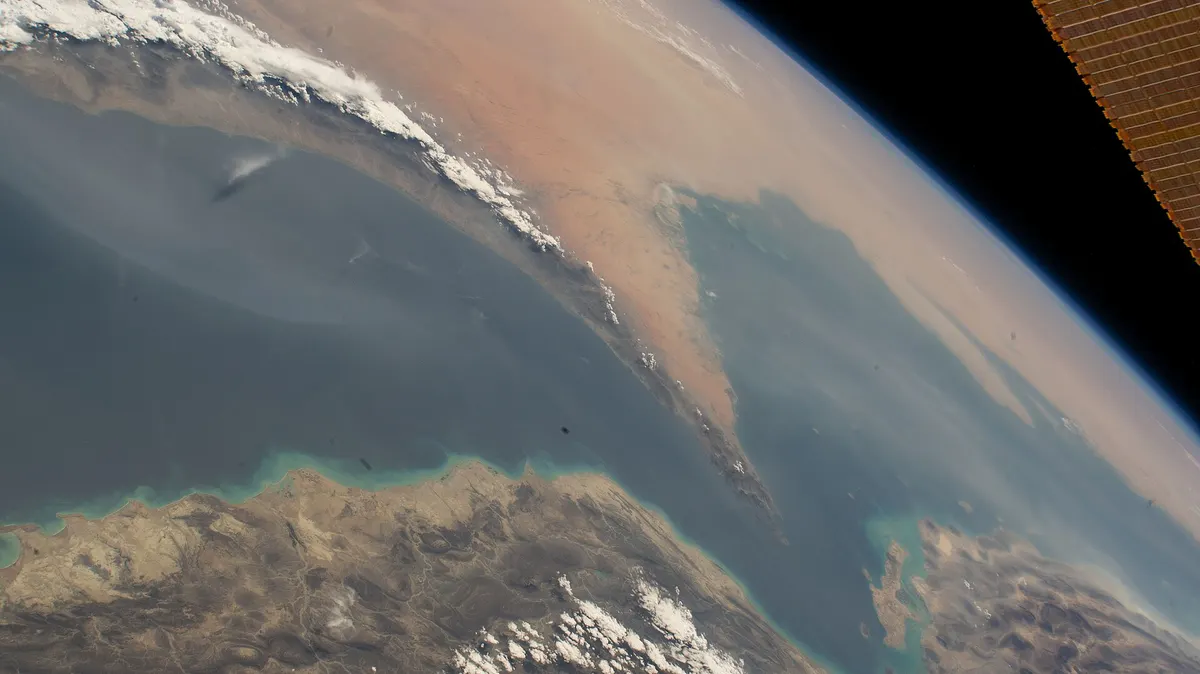
Sourcing: Araghchi's quotes are from his Oct. 31, 2026 interview with Al Jazeera, as carried in Al Jazeera, AP, Dawn, Tehran Times (Iranian state-aligned) and Iran International (Iranian opposition-aligned). The two-day timeline and the conditions are Iran's stated proposal; neither the U.S. nor Qatar had confirmed its terms as of publication. Oil prices are Reuters' Friday settlement figures as carried in Iran International. The gas price is AAA's national average for Oct. 31. The hero photo is a 2022 NASA image from the International Space Station, not from this week.
Like US Brief? You can support it with a tip.