
France deploys 70,000 police as Saturday protests face bans
France will deploy 70,000 police and gendarmes for Saturday protests, a week after riots followed marches of about 550,000 people. President Emmanuel Macron wants non-union marches banned where possible and blames far-left groups; France Unbowed, a left-wing party, and union leaders say protest rights are being undermined.
AI-assisted · US Brief desk · Sources listed below
What happened
Interior Minister Laurent Nuñez said Friday that 70,000 security forces, including elite units, "around 20" armored vehicles and 15 water cannon vehicles, will be deployed for Saturday's protests. "We have noted numerous calls from far-left and radical far-left movements," he said, according to France 24. He said nearly 500 people have been identified and arrested in investigations into the Oct. 17 violence.
Why it matters
Saturday is the first test of the government's tougher approach since the Oct. 17 riots. An Interior Ministry official said the deployment is about 20% larger than last week's, and museums and transit in major cities are shutting down for the day.
More context
The bans: Macron said Thursday, "The general recommendation is that there should be no demonstrations," adding that "when they're not union organisations, wherever possible, they'll be banned," the BBC reported. Marseille and Lyon imposed total bans for the weekend, Marseille is suspending public transit Saturday, and a Paris curfew around Place de la République and Les Halles (11 p.m. to 6 a.m.) is extended to Monday. The Louvre, Orsay and Picasso museums will close Saturday, and Art Basel Paris canceled its weekend program.
Timeline: On Oct. 17 about 550,000 people marched nationwide and riots followed; the Limoges city hall clock tower was burned. Justice Minister Gérald Darmanin said 2,700 people have been arrested, more than 1,000 have appeared in court and 217 have been jailed, half with no prior record (BBC). This week an administrative court suspended a Paris ban on a student march (France 24).
The government's case: Macron decried "political and even seditious acts organised by far-left groups that aim to bring down the Republic," arguing bans and a larger police presence are needed to stop a repeat of last weekend.
The critics' case: France Unbowed (LFI), a left-wing party, called the measures an "authoritarian slide," and its MEP Manon Aubry said "the right to protest is being severely undermined." Marylise Léon, head of the CFDT union, said, "It is not up to the President of the Republic to decide who is legitimate."
Weak spot (critics): Claims that protest rights are being erased sit awkwardly with this week's administrative court ruling suspending the Paris student-march ban, a sign that courts are still reviewing and overturning bans (France 24).
Weak spot (government): Darmanin's own figures show half of those jailed had no prior record, which complicates the government's framing of the unrest as mainly organized far-left action.
What's still unknown: Turnout Saturday, whether more courts lift local bans, and whether the bigger deployment prevents violence. French elections are scheduled for April 18 and May 1, the BBC noted.
3 listed sources
References listed by US Brief; a source count is not a verification score.
Editorial sourcing notes
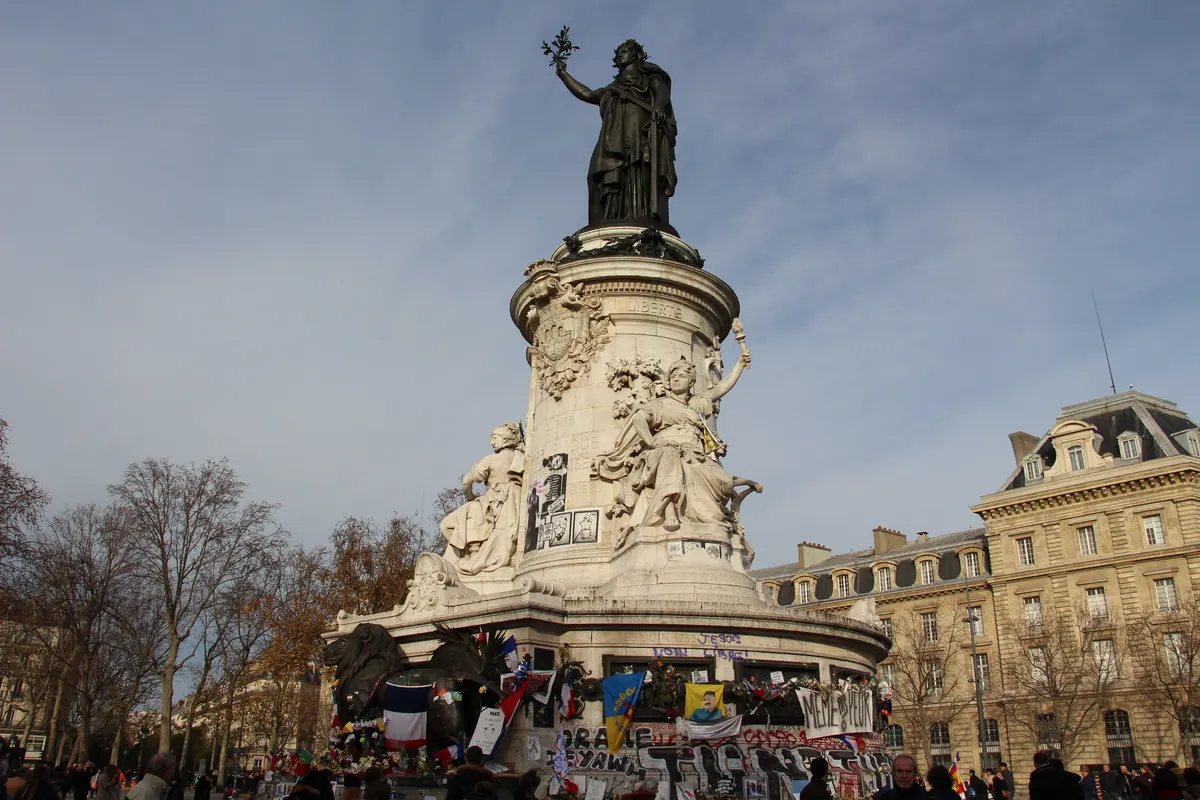
Sourcing: France 24 for Friday's deployment figures and reaction; BBC for Macron's remarks, the bans and arrest numbers. Both photos are file images (2015 and 2019), not this week's events.
Like US Brief? You can support it with a tip.