
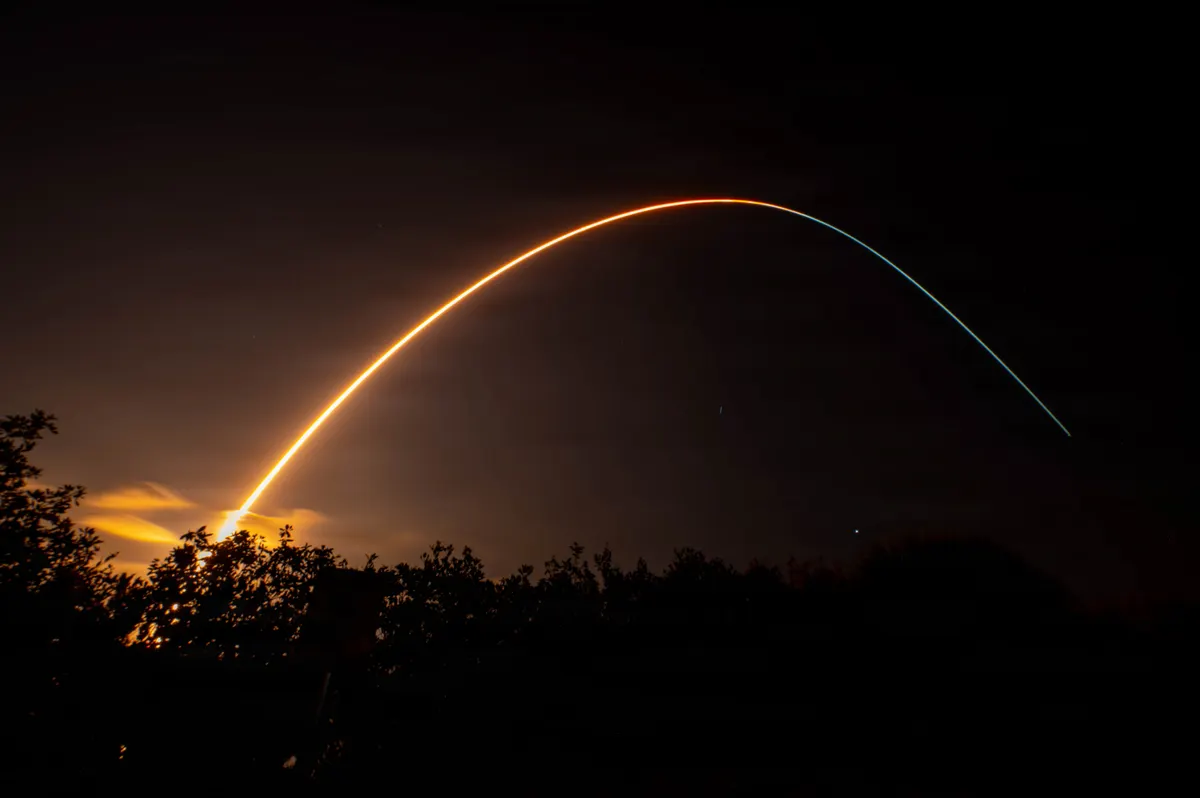
Vulcan rocket fails, destroying 40 Amazon satellites built to rival Starlink
A United Launch Alliance Vulcan rocket failed about 10 minutes after liftoff from Florida on Sunday, losing all 40 Amazon Leo internet satellites aboard. It is the first total mission failure in ULA's 20-year history, and it is likely to ground the rocket that Amazon and the U.S. military both rely on.
AI-assisted · US Brief desk · Sources listed below
What happened
A United Launch Alliance Vulcan rocket carrying 40 Amazon Leo broadband satellites failed on its way to orbit Sunday, destroying the whole payload. The rocket lifted off from Space Launch Complex 41 at Cape Canaveral Space Force Station, Florida, at 9:40 a.m. PT. About 50 minutes later, ULA said the rocket "suffered an anomaly 10 minutes into the flight and failed to deliver the Amazon mission to orbit."
It was the first total mission failure for ULA, a Boeing and Lockheed Martin joint venture, since it was formed in 2006, Reuters and Spaceflight Now reported. It was only the fifth Vulcan flight and the first in nine months. ULA had paused to fix problems with strap-on solid rocket boosters that affected two earlier flights, in 2024 and this past February. Those boosters appeared to work normally Sunday, according to Spaceflight Now and Ars Technica.
"ULA exists to provide assured access to space for our nation and for the customers who depend on us," the company said, according to Ars Technica. "Today, we did not meet that standard." ULA said it would find the cause, fix it and "return to flight as quickly as possible."
Why it matters
Vulcan is under contract to fly roughly half of the U.S. military's national security launches in the next few years, Ars reported. A grounding could push more of those missions to SpaceX, which already took over six such launches from ULA after earlier Vulcan delays. NASA Administrator Jared Isaacman offered help on X: "Artemis, Moon Base, and the nation need ULA." NASA plans to use a version of ULA's Centaur upper stage on future Moon rockets.
More context
The hit to Amazon: Sunday's launch was the first of 38 Vulcan flights Amazon bought for Amazon Leo, its satellite internet service built to compete with Elon Musk's Starlink. The network has 396 satellites in orbit, Ars reported, out of 3,292 planned for its first generation. Amazon told Ars in October it has enough satellites to start initial service by the end of the year. "There is risk with any launch," Amazon said Sunday, adding that it believes ULA will "learn from this mission."
Amazon's other rides are limited. Blue Origin's New Glenn has been grounded since a pad explosion in May. Amazon has 10 more Falcon 9 launches booked with SpaceX, and a fourth Ariane 6 launch for Amazon is set for later this month from French Guiana, Ars reported. Amazon has also booked 24 New Glenn flights and 24 Ariane 6 flights in total, according to Spaceflight Now.
Two early accounts of what failed: ULA's first update pointed to a problem during the burn of the Centaur upper stage, Spaceflight Now reported. Ars Technica, citing multiple unnamed sources, said the problem was in the booster stage, not the Centaur or the solid boosters. Both outlets noted that the booster's two Blue Origin-built BE-4 engines fired longer than planned, by at least 30 seconds according to Ars. That could mean the stage was underperforming, Ars said.
What's still unknown: the root cause; whether a countdown hold at T-minus 20 seconds Sunday played any role, which Spaceflight Now said is not yet known; whether the BE-4 engines, which Blue Origin had retrofitted with a valve fix after the New Glenn explosion, were involved; and how long Vulcan will stay grounded. If the BE-4 is at fault, it could also delay New Glenn's return to flight, Ars reported.
4 listed sources
- Reuters (via Investing.com), US rocket fails after launch, payload of Amazon internet satellites destroyed, Nov. 15, 2026:
- Spaceflight Now (William Harwood), ULA suffers first outright failure with loss of Vulcan rocket carrying 40 Amazon Leo satellites, Nov. 15, 2026:
- Ars Technica (Stephen Clark), Vulcan rocket fails during launch, dealing major blow to SpaceX competitors, Nov. 15, 2026:
- The Verge, Vulcan rocket fails, destroying 40 Amazon Leo satellites (includes ULA and Amazon statements), Nov. 15, 2026:
References listed by US Brief; a source count is not a verification score.
Editorial sourcing notes
The cause of the failure has not been announced. ULA's first update pointed to the Centaur upper-stage burn, Spaceflight Now reported; Ars Technica cites unnamed sources who place the problem in the booster stage. Both accounts are early and may change. Hero photo is a file image of a Vulcan launch on Feb. 12, 2026, not Sunday's flight. Liftoff time converted from 12:40 p.m. ET.
Like US Brief? You can support it with a tip.