
Voyager 1 becomes first spacecraft one light-day from Earth
NASA's Voyager 1 crossed one light-day from Earth, about 16.1 billion miles, at 5:16 a.m. EST Wednesday, the first human-made object to get that far. A radio command now takes a full day to reach the 49-year-old probe, which is down to two working science instruments.
AI-assisted · US Brief desk · Sources listed below
What happened
Voyager 1 became the first human-made object to reach one light-day from Earth at 5:16:07 a.m. EST (2:16 a.m. PST) on Wednesday, Nov. 18, NASA said. That is the distance light travels in 24 hours, about 16.1 billion miles. A command sent from NASA's Deep Space Network now takes a full day to reach the spacecraft, and its reply takes another day to come back, Spaceflight Now reported. The probe is moving at nearly 38,000 mph.
Why it matters
The milestone shows how far 1970s engineering has carried the mission, but the probe is running down. NASA turned off its Cosmic Ray Subsystem in February 2025 and its Low-Energy Charged Particle instrument in April 2026 to save power, leaving only the magnetometer and the plasma wave instrument. Its nuclear power supply loses about 4 watts a year, and JPL expects enough power to keep talking to Earth through about the early 2030s, Spaceflight Now reported.
More context
What the team said: "It has never happened before. It may never happen again," said Kareem Badaruddin, Voyager's interstellar mission manager and one of three full-time team members keeping the two probes running. Alan Cummings, a Caltech scientist who has worked on the mission since before launch, told Spaceflight Now the mark is "not a scientific milestone" but "an engineering milestone," a tribute to the people who built a craft to last this long.
By the numbers: NASA puts one light-day at 16,094,799,096 miles (25,902,068,356 kilometers). Light reaches the Moon in 1.3 seconds and Neptune in about four hours and 10 minutes. Voyager 1 took 49 years, two months and 11 days to cover one light-day. Its twin, Voyager 2, was more than 13.4 billion miles away as of Wednesday and should reach the same mark in November 2035.
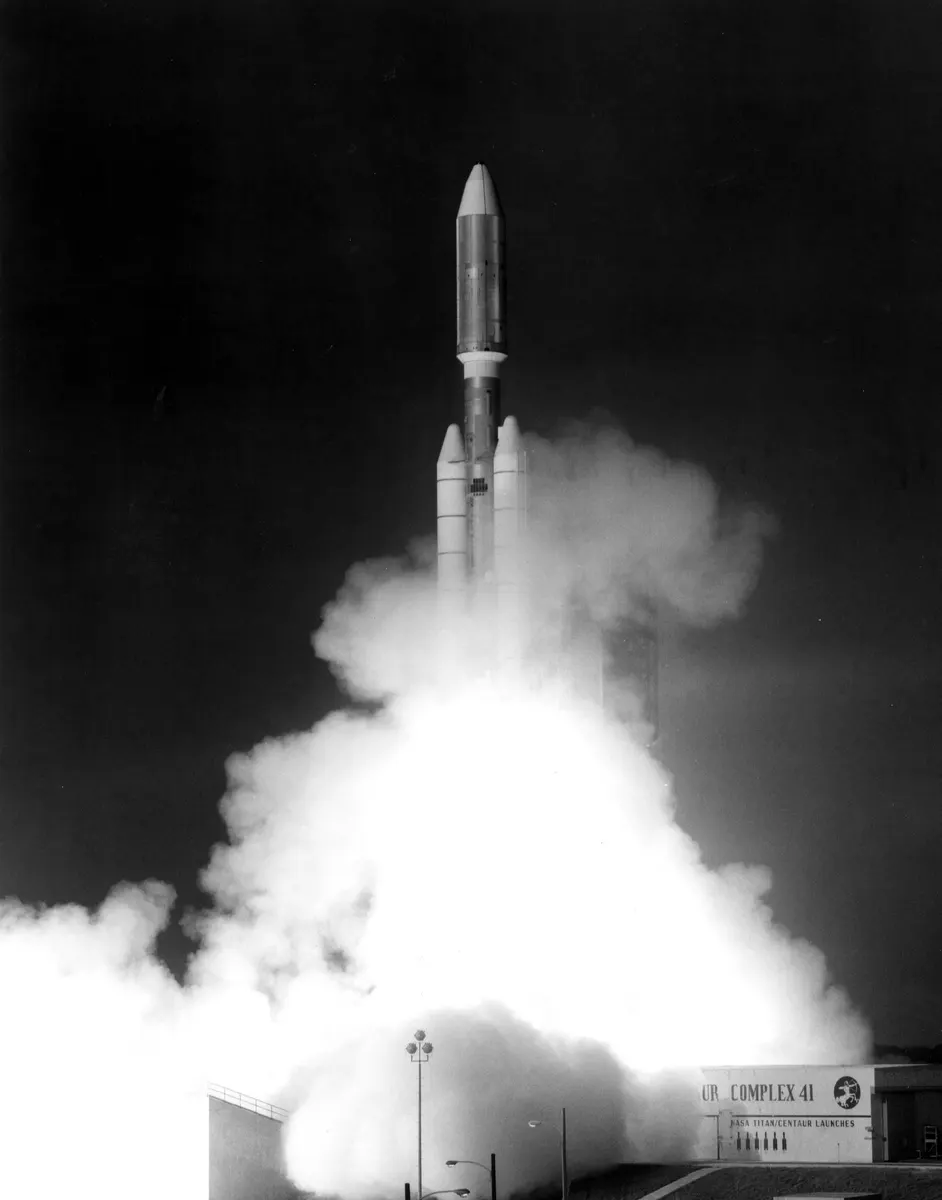
A short timeline: Voyager 1 launched Sept. 5, 1977, on a Titan 3E-Centaur rocket from Cape Canaveral. It flew past Jupiter in March 1979 and Saturn in November 1980. On Feb. 14, 1990, it took the "Pale Blue Dot" image of Earth. It became the most distant human-made object on Feb. 17, 1998, and crossed into interstellar space on Aug. 25, 2012.
What it carries: Each Voyager carries the Golden Record, a 12-inch gold-plated copper disk with 115 images, greetings in 55 languages, natural sounds and about 90 minutes of music, Spaceflight Now said. NASA says Voyager 1 is headed toward a star called Gliese 445 and will pass within about 1.7 light-years of it in 40,000 years.
What's still unknown: The Deep Space Network failed to detect Voyager 1's signal on Oct. 18 and 19, and contact resumed Oct. 20. Engineers found that one group of thrusters had gone offline and the fault protection system had switched to backups, but as of JPL's Oct. 29 update the cause was still under investigation, Spaceflight Now reported. "This is the first time we've seen the spacecraft do something like this," Badaruddin said then.
3 listed sources
- NASA Science, What Is a Light-Day? (Voyager 1), Nov. 2026
- Spaceflight Now (Houston Harwood), NASA's Voyager 1 is one light-day from Earth, Nov. 18, 2026
- NASA Science, Voyager One Light-Day Downloads, Nov. 2026
References listed by US Brief; a source count is not a verification score.
Editorial sourcing notes
The hero photo shows Voyager 1's launch from Cape Canaveral on Sept. 5, 1977 (NASA file photo).
Like US Brief? You can support it with a tip.