
Google says Willow chip cut quantum 'magic state' errors 40-fold
Google Quantum AI reported in Science that a technique called magic state cultivation cut errors about 40-fold on its Willow processor, reaching 99.99% fidelity. It is a hardware first for the method, but the result still falls far short of what practical quantum computing needs.
AI-assisted · US Brief desk · Sources listed below
What happened
Google Quantum AI said Thursday that it had shown a technique called magic state cultivation working on real hardware for the first time. In a paper published in Science, the team reported that the method cut errors about 40-fold on its 105-qubit Willow processor compared with states that weren't cultivated, producing so-called T-states with a measured fidelity of at least 99.99%. The experiment used 54 of Willow's physical qubits, Scientific American reported.
Why it matters
The cost of making magic states is a big reason estimates for a useful, error-corrected quantum computer run to very large machines. If cultivation keeps working as it scales, the same work could be done with far fewer qubits, which would bring practical machines closer. Google's blog said that "plenty of technical challenges remain" and that the method still has to be shown at a larger scale.
More context
Why magic states matter: Most quantum error-correction schemes handle a basic set of operations, called Clifford gates, cheaply, but those alone can be imitated by ordinary computers. Running useful quantum programs also needs a non-Clifford operation, usually a T gate, which consumes a carefully prepared "magic state" each time it runs. Lead author Emma Rosenfeld told Scientific American that the standard way of making them, called distillation, can take "up to 95 percent" of a quantum computer. Cultivation instead starts with a rough state on a few qubits, checks it, throws out flawed attempts and grows the survivors into a larger, better-protected code.
What Google is claiming: In a company blog post, Rosenfeld and Craig Gidney, one of the method's 2024 designers, called it "the first demonstration of a practical solution" to one of quantum computing's worst resource bottlenecks. The team also moved cultivated states from a small "color code" into a larger "surface code," the error-correction layout Google's chips use. CEO Sundar Pichai wrote on X that it was "some magical progress" and "a 40x error reduction on our Willow processor vs. previous methods."
The outside view: Kenneth Brown, director of the Duke Quantum Center, who was not involved, told Scientific American that "the Google experiment shows that cultivation works in practice." He also pointed to the catch: the quality check rejects low-grade states, so 92% of attempts were thrown away. The paper itself says 8% of attempts were kept.
How far from practical (US Brief comparison, from Scientific American's figures): Google's magic states now fail roughly once in 10,000 tries. Simulating molecules, the use Rosenfeld called more attainable, would need about one failure in a million to one in 100 million. Breaking today's RSA-2048 encryption, used in website security and banking, would need about one in 10 billion. That means the result is a real step, but still several orders of magnitude from either goal.
What remains unknown: whether the error rate keeps falling as the codes get bigger; how much the 92% discard rate slows a full computation; and when Google or its rivals will show a complete error-corrected T gate rather than a prepared state. Google gave no timeline. The paper was received by Science in December 2025 and accepted Oct. 1, 2026, and a preprint has been public on arXiv since December 2025.
5 listed sources
- Science, "Magic state cultivation on a superconducting quantum processor" (Google Quantum AI and collaborators), First Release Oct. 15, 2026
- Google Keyword blog, Oct. 15, 2026
- Scientific American, Oct. 15, 2026
- Sundar Pichai on X, Oct. 15, 2026
- arXiv preprint 2512.13908
References listed by US Brief; a source count is not a verification score.
Editorial sourcing notes
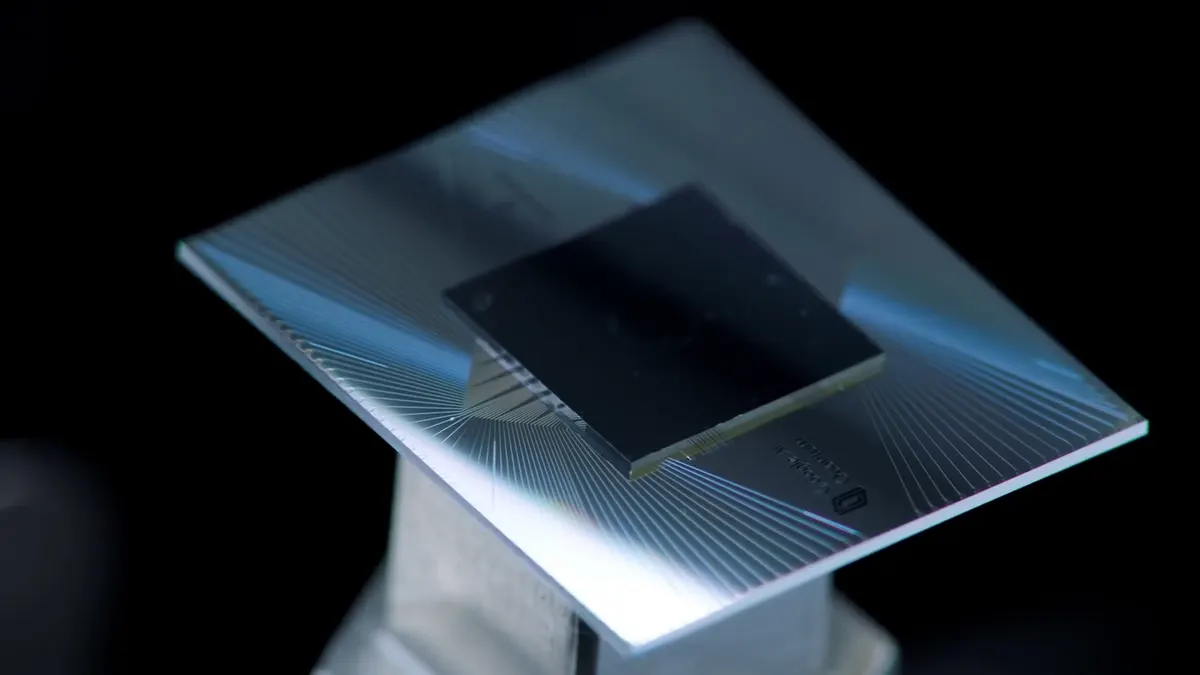
The 40-fold and 99.99% figures are Google's own measurements as reported in its peer-reviewed Science paper; the error-rate targets for chemistry and code-breaking come from Scientific American's reporting. The hero photo is a 2019 file image of Google's earlier Sycamore processor, not the Willow chip used in this experiment.
Like US Brief? You can support it with a tip.