
Google's Project Suncatcher TPU satellite is in orbit after SpaceX launch
Google said its Project Suncatcher prototype satellite, built with Planet, launched Oct. 1 on SpaceX's Transporter-18 rideshare and that the company has confirmed contact. The craft carries Google Trillium TPUs to test whether machine-learning chips can work in space.
AI-assisted · US Brief desk · Sources listed below
What happened
Google said its Project Suncatcher prototype satellite reached orbit Oct. 1 on a SpaceX Falcon 9 Transporter-18 rideshare and that the company has confirmed contact. The craft was built with Planet Labs and carries Google Trillium Tensor Processing Units, the company said.
What launched: Travis Beals, senior director of Google's Paradigms of Intelligence team, wrote that the team confirmed contact and that the satellite is "operating as expected." Scientific American put liftoff at about 2:32 p.m. EDT from Vandenberg Space Force Base. Gunter's Space Page lists the payload as Suncatcher 1 on Falcon 9 from Va SLC-4E.
What it tests: Google called the flight the first step in a long-term research effort on whether space could host scalable machine-learning infrastructure. Over coming weeks it plans to gather data on how the TPUs handle launch stress, radiation, and thermal extremes. Google also published a related peer-reviewed paper in Joule, the blog said.
Why it matters
Tech firms are looking for more power and land for AI chips. An early in-orbit TPU test is a high-interest milestone, even if commercial space compute remains years away.
What’s next
In-orbit thermal and radiation data over the next weeks and months, then the planned 2027 dual-satellite link demonstration.
More context
Hardware detail: Secondary reporting by TechTimes said the refrigerator-sized craft, internally called MVP, carries four Trillium-generation TPUs and is expected to run compute in roughly 15-minute bursts before cooling in vacuum. Those hardware and duty-cycle figures are not in Google's short launch post and should be treated as attributed secondary detail.
What it is not: Google is not claiming an orbital data center. Scientific American noted experts still warn about engineering and cost hurdles, and that astronomers have raised light-pollution concerns about large orbital compute plans. Google said it plans two experimental satellites in 2027 to test laser links between craft.
6 listed sources
- Google Research blog (Travis Beals), Oct 1, 2026: Our Project Suncatcher prototype satellite is in orbit
- Scientific American (Adam Kovac), Oct 1, 2026: Google's Project Suncatcher AI data center test has officially launched to space aboard SpaceX rocket
- Gunter's Space Page: Suncatcher 1, 2
- TechTimes (Zachary Chambers), Oct 2, 2026: Google Project Suncatcher reaches orbit; cooling, not radiation, now defines mission
- Space.com, Oct 1, 2026: SpaceX launches Google AI satellite, 129 other payloads on Transporter-18
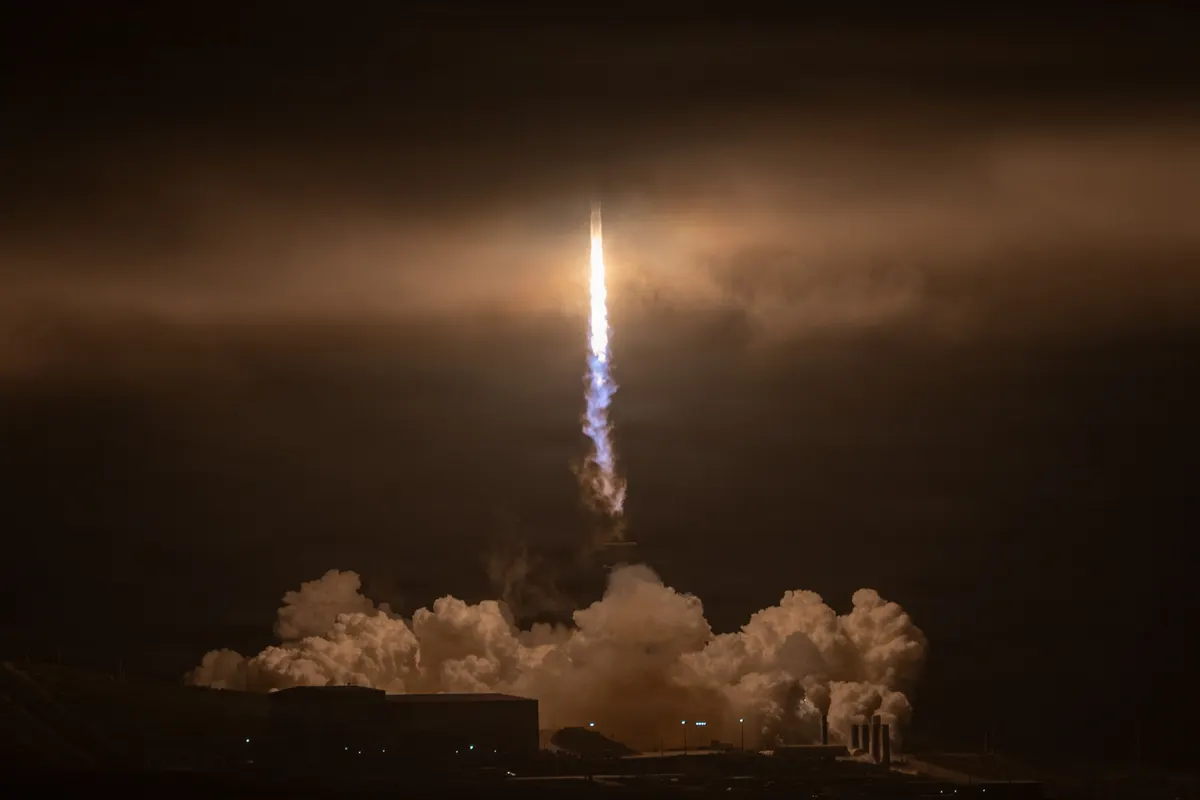
- Sourcing note: Launch and contact confirmation come from Google's Oct 1 blog and Scientific American. Four-TPU and thermal duty-cycle detail are from TechTimes secondary reporting and are attributed. Gunter's Space Page lists the satellite catalog entry. Hero photo is a U.S. Space Force file of a prior Transporter rideshare from Vandenberg, not the Oct 1 flight. Re-check 5:38 AM PT Oct 4: added Space.com launch confirmation; no new Google update.
References listed by US Brief; a source count is not a verification score.
Editorial sourcing notes
Lead: Google Research blog (Travis Beals), Oct 1, 2026 — prototype launched on Transporter-18 with Planet; contact confirmed; operating as expected; Joule paper. Scientific American (Adam Kovac), Oct 1 — ~2:32 p.m. EDT lift-off; TPU radiation ground tests at UC Davis; cooling system; 2027 two-satellite laser-link plan. Gunter's Space Page: Suncatcher 1, COSPAR 2026-227, Va SLC-4E, Falcon-9, Oct 1, 2026. TechTimes (Zachary Chambers), Oct 2 — four Trillium TPUs, ~15-minute compute/cool cycle, MVP name — attribute secondary detail. Caveats: early prototype, not an orbital data center; launch photo is Transporter-17 Vandenberg file, not Oct 1. Re-check ~5:20 AM PT Oct 4: Google blog + SciAm remain primary.
Like US Brief? You can support it with a tip.