
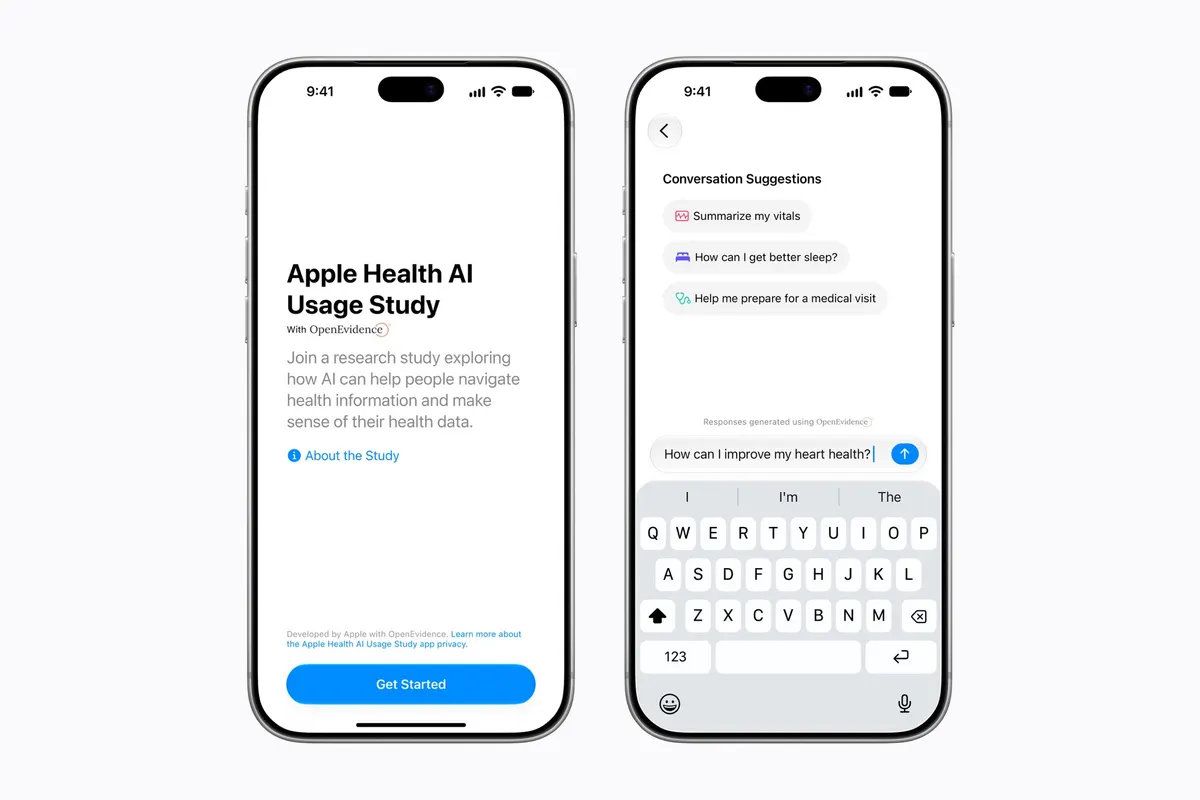
Apple opens AI health study to 200,000 iPhone users with OpenEvidence
Apple has launched the Apple Health AI Usage Study, a U.S. research app built with OpenEvidence that answers everyday health questions with cited medical sources. Up to 200,000 adults 21 and older can join if they have an Apple Intelligence iPhone on iOS 26. Apple says study data won't train AI models.
AI-assisted · US Brief desk · Sources listed below
What happened
Apple on Sunday launched the Apple Health AI Usage Study, a virtual research study with its own app, in the United States. Participants can ask everyday health questions and get answers written in plain language, with links to peer-reviewed sources. The answers come from OpenEvidence, a clinical AI tool used by doctors that draws on journals such as The New England Journal of Medicine, JAMA and Nature, Apple said.
Why it matters
People already ask chatbots medical questions at scale: OpenAI said earlier this year that users ask more than 300 million health-related questions a week, TechCrunch noted. Apple says the study aims to inform the responsible design of health AI by testing what drives trust, answer quality and understanding.
More context
Who can join: Up to 200,000 adults age 21 and older in the U.S. You need an Apple Intelligence-enabled iPhone (iPhone 15 Pro or later) running iOS 26 or later, according to Apple. The study app is on the App Store. The study will run for more than 12 months, and participants will be asked to rate answers and fill out monthly surveys, TechCrunch reported.
Your health data: Participants can choose to share HealthKit data such as resting heart rate, activity, sleep or lab results to see whether personal data makes answers more useful, Apple said. Study data will not be used to train AI models. TechCrunch reported that data is anonymized before going to a secure third-party cloud, and that OpenEvidence deletes questions and answers after 24 hours. The app can also build a summary to help people prepare for doctor visits.
Guardrails: Apple says the app is "not meant to diagnose or treat any condition, or replace the advice of medical professionals." It is designed to spot certain concerning questions and suggest following up with a provider. "Health is deeply personal," said Sumbul Desai, M.D., Apple's vice president of Health and Fitness.
What we don't know: whether Apple plans to bring AI health answers to the Health app or Siri, which TechCrunch said is unclear; how Apple will publish the results; and how accurate the answers turn out to be in everyday use.
4 listed sources
- Apple Newsroom, Apple launches research study to explore the use of AI for health, Nov. 15, 2026:
- TechCrunch (Ivan Mehta), Apple launches new app to study how people use AI for health, Nov. 15, 2026:
- The Verge, Apple's new study looks to improve the effectiveness of AI health tools, Nov. 15, 2026:
- App Store, Apple Health AI Study App listing:
References listed by US Brief; a source count is not a verification score.
Editorial sourcing notes
Details come from Apple's announcement and TechCrunch's reporting. TechCrunch lists the iPhone 15 or later as eligible; Apple's announcement says an Apple Intelligence-enabled iPhone, iPhone 15 Pro or later. US Brief uses Apple's wording. The app is a research study, not medical advice.
Like US Brief? You can support it with a tip.