
Trump says $4 billion a year in aid to Israel ends this year
On Election Day morning, President Trump said the U.S. will stop roughly $4 billion in yearly military aid to Israel by the end of 2026, an idea he said Prime Minister Benjamin Netanyahu raised; Israel could still buy U.S. weapons, but Congress controls the money and the current aid pact runs through 2028.
AI-assisted · US Brief desk · Sources listed below
What happened
President Donald Trump said Tuesday that the United States will stop sending Israel about $4 billion a year in aid by the end of 2026. "We were giving them $4 billion – we are – but it gets cut off at the end of the year," he said in a phone interview with Fox & Friends as voters went to the polls, according to Fox News.
Trump said Israeli Prime Minister Benjamin Netanyahu raised the idea. "He said, 'I think it would be appropriate if we do not receive aid,'" Trump said, adding that Israel is "a very thriving country" that no longer needs the money. He said Israel can still buy American weapons with its own funds: "They can buy whatever they want." Netanyahu's office declined to comment, NBC News reported. Two sources at Israel's Finance Ministry told ABC News they were surprised by the remarks, noting that next year's budget was drafted around the current agreement.
Trump openly tied the timing to the midterms. He said critics on the left use the aid as "a signal of unfairness" and singled out Abdul El-Sayed, the Democratic Senate nominee in Michigan. "Why should we suffer the slings from lunatics like an El-Sayed when they don't need it?" Trump said. He also cast the move as a way to help balance the federal budget.
Why it matters
Israel has been the largest recipient of U.S. military aid, and roughly $3.8 billion a year is at stake. An early cutoff would change how Israel pays for American weapons, and because Congress, not the president alone, decides the funding, the next Congress elected today will have a say in whether it happens.
More context
The money Trump described comes mostly from a 10-year, $38 billion agreement signed in 2016. It covers fiscal years 2019 through 2028 and promises $3.3 billion a year in military financing grants plus $500 million a year for joint missile defense, or $3.8 billion a year, according to the Congressional Research Service and NBC News.
What the evidence shows: Trump's "end of the year" timeline runs ahead of the paperwork. The current agreement is not slated to end until fiscal 2028, and the Congressional Research Service notes that such agreements are not legally binding and that Congress decides each year how much aid to fund. The White House did not explain to PolitiFact how the aid would stop early. (Source: [CRS, June 2026](https://www.congress.gov/crs-product/IN12695); [PolitiFact, Nov. 3](https://politifact.com/article/2026/nov/03/trump-netanyahu-israel-gaza-el-sayed-michigan/).)
The phaseout idea is not new. Netanyahu wrote in a June 1 letter to Rep. Marlin Stutzman (R-Ind.) that "the time has now arrived for us to move from aid recipient to partner," and Secretary of State Marco Rubio told House appropriators in June that Israel wanted to taper aid to zero within 10 years, PolitiFact reported. That is a much slower pace than the one Trump described.
Other U.S. support would continue. Israel has about $9 billion in active U.S. loan guarantees, one expert told PolitiFact, and Congress set aside $202 million for joint U.S.-Israeli defense programs outside the agreement for fiscal 2026, according to CRS. A House-passed defense bill would also tie Israel more closely into U.S. military research; the Senate has not voted on it.
Reaction split along unusual lines. In Israel, opposition figure Gadi Eisenkot said Netanyahu "can no longer be trusted, and he must be replaced," and Democrats party leader Yair Golan called the cutoff "a severe blow to Israel's security," NBC News reported. In the U.S., aid has become a campaign issue: a Chicago Council on Global Affairs poll in July found about 56% of Americans want military aid to Israel cut or stopped, up from 38% in 2012, according to PolitiFact.
Markets read the remarks as a sign of lower war risk. Brent crude fell as much as 3.3% to $101.32 a barrel after the interview, its lowest since Oct. 8, Reuters reported, before trading around $103.44, down about 1%, by early afternoon Eastern time.
How it got here: In January, Netanyahu said he hoped to "taper off" U.S. military aid over the next decade (NBC News). On June 1 he wrote to Rep. Stutzman about moving from "aid recipient to partner," and in June Rubio told House appropriators Israel wanted aid to reach zero within 10 years (PolitiFact). On June 4, the Congressional Research Service laid out the choices facing Congress, noting the aid agreement is not legally binding. On Nov. 3, Trump said the aid would end by year's end.
What's still unknown: whether the White House will put the change in writing, which funds stop first (the $3.3 billion in grants, the $500 million for missile defense, or both), what happens to weapons orders already paid for with U.S. grants, and whether the next Congress, whose makeup voters are deciding today, will go along.
Sources across the spectrum This story cites right-leaning and left-leaning outlets. Every source is listed below.
6 listed sources
- Fox News, Trump says Israel will stop receiving $4B in US aid by year's end, can still buy weapons, Nov. 3, 2026
- NBC News, U.S. will stop $4B in aid to Israel at the end of the year, Trump says, Nov. 3, 2026
- ABC News, Trump says $4 billion in Israel military aid will end this year, citing political reasons, Nov. 3, 2026
- PolitiFact, Trump's Election Day surprise: End US aid to Israel. But other strong financial ties would remain., Nov. 3, 2026
- Reuters (via Euronext), Oil prices slide after Trump comment on stopping Israel aid, Nov. 3, 2026
- Congressional Research Service, Possible Changes in U.S. Military Aid to Israel: Considerations for Congress (IN12695), June 4, 2026
References listed by US Brief; a source count is not a verification score.
Editorial sourcing notes
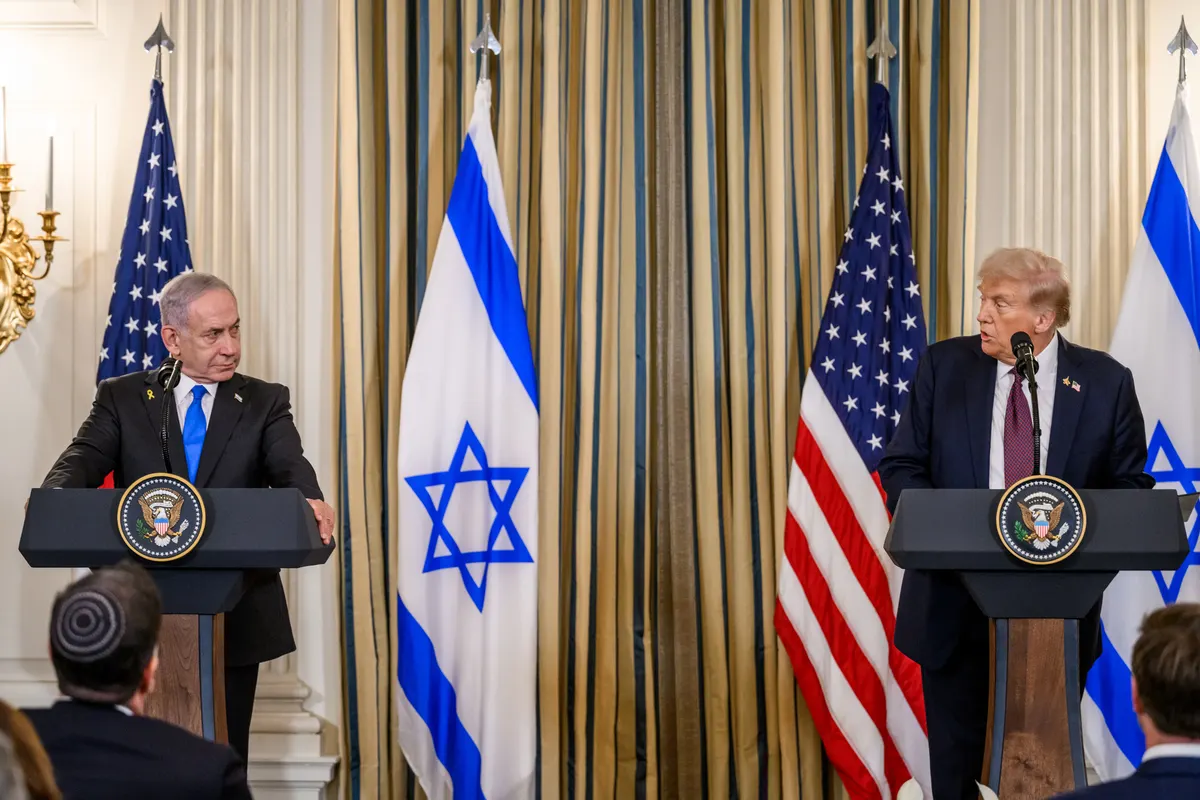
The announcement rests on President Trump's remarks in a Nov. 3 phone interview with Fox & Friends, as Fox News, NBC News, Reuters and PolitiFact reported them. Netanyahu's office declined to comment to NBC News, Israeli Finance Ministry sources spoke to ABC News anonymously, and the White House did not give PolitiFact details on how or when the aid would stop. Background on the 2016 aid agreement comes from the Congressional Research Service. Photos are White House file photos from 2025, not from today.
Like US Brief? You can support it with a tip.