
Both Sides: Should the US join Saudi strikes on the Houthis?
After a missile attack on Riyadh's main airport killed 12 people, including an American, President Trump said the US "may" join Saudi strikes on Yemen's Houthis. Here is the strongest case for and against, plus the war powers resolution already filed in the House.
AI-assisted · US Brief desk · Sources listed below
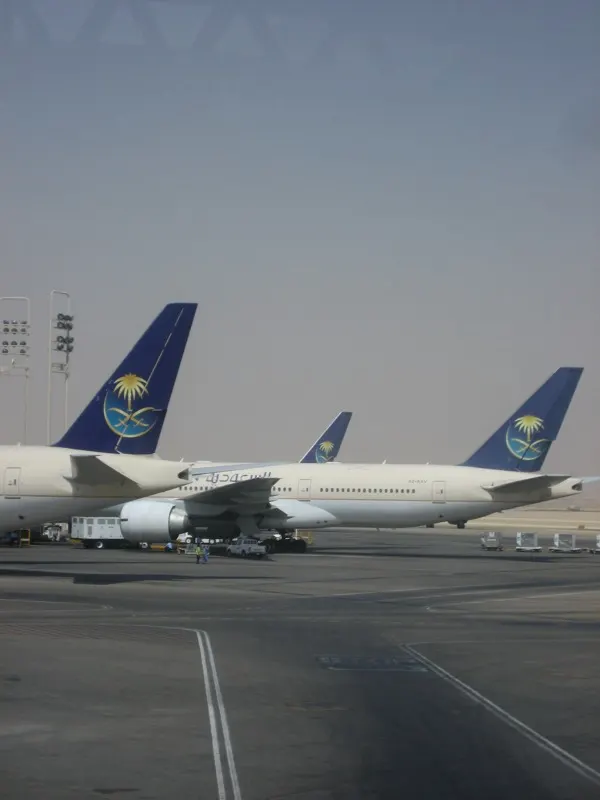
What happened
A missile struck the terminal complex of King Khalid International Airport in Riyadh on Saturday, Oct. 10, killing 12 people and injuring more than 300, Saudi authorities said. The dead included four Saudis and people from Bangladesh, Egypt, Jordan, Syria, Sudan, the Palestinian territories and the United States. The Saudi-led coalition blamed Yemen's Iran-backed Houthis, who had claimed earlier attacks on the airport this week. AP called it the deadliest attack in any Gulf Arab country since the Iran war began. The airport stayed closed into Sunday.
Why it matters
Until now, the administration's line had been "no offensive strikes." CNN reported in September that US help was limited to intelligence and targeting data, despite two calls from Crown Prince Mohammed bin Salman asking for US strikes. A US role would open a new front weeks before the Nov. 3 midterms, while the war with Iran stays unpopular: 69% of Americans said it had not been worth fighting in an Oct. 1 AP-NORC poll cited by TIME.
More context
Hours later, President Trump said on the White House South Lawn that the US "may" join Saudi strikes on the Houthis. "We're going to look at it," he said. "We just found out about the recent attack. So we'll make a decision. We move very quickly." Secretary of State Marco Rubio condemned "the terrorist Houthis" and confirmed an American was killed. As of early Sunday, no US decision had been announced.
The strongest case for joining: Supporters argue the Houthis are a designated Foreign Terrorist Organization that has now killed an American and is attacking a civilian airport, which Saudi officials called a "war crime." They argue that Houthi moves on the Bab el-Mandeb strait threaten a second oil chokepoint on top of Hormuz, worsening fuel prices at home. Regional officials told CNN that "at least the possibility of US involvement needs to hang over everyone to act as a deterrent," and Saudi forces have struggled to stop Houthi advances alone. Right-leaning outlets including the Washington Examiner, New York Post and Fox News led with the American death and Trump's openness to a response.
The strongest case against: Critics argue Congress has not authorized hostilities against the Houthis, and that the 2025 US bombing campaign ended in a ceasefire without dislodging the group. Gulf sources told CNN that military action "will weaken them, yes, but will not end them." Rep. Ro Khanna (D-Calif.) and Rep. Thomas Massie (R-Ky.) filed a War Powers resolution on Oct. 9, the day before the airport strike, to pull US forces out of unauthorized hostilities in Yemen. Opponents also warn that strikes could unravel the US-Houthi ceasefire that has largely kept the group from targeting US ships.
Primary document: H.Con.Res. 124 says "Congress has not declared war with respect to, or provided any specific statutory authorization for" hostilities against the Houthis, "including direct United States airstrikes" as well as "intelligence sharing, targeting support, midair refueling." It says more than 200 US troops have been placed in a new joint forces command in Saudi Arabia. The resolution was referred to the House Foreign Affairs Committee.
What would change the story: A Houthi claim (or denial) for Saturday's strike; a formal War Powers notification to Congress, which the law requires within 48 hours of introducing forces into hostilities; the outcome of Trump's planned call with the crown prince; and any Houthi threat against US ships if Washington joins.
Sources across the spectrum This story cites right-leaning and mainstream or left-leaning outlets. Every source is listed below.
9 listed sources
- AP via Boston Globe, Oct. 11, 2026
- NPR, Oct. 10, 2026
- TIME, Oct. 10, 2026
- Washington Examiner, Oct. 10, 2026
- New York Post, Oct. 10, 2026
- Fox News video, Oct. 10, 2026
- CNN, Sept. 19, 2026
- H.Con.Res. 124 (119th Congress), introduced Oct. 9, 2026
- Congressional Research Service, U.S. Strikes on Houthi Targets in Yemen Raise War Powers Issues
References listed by US Brief; a source count is not a verification score.
Editorial sourcing notes
Facts: Saudi civil aviation authority figures via AP/NPR and TIME; Trump quotes from the South Lawn on Oct. 10 (TIME, Fox News video). Right-leaning outlets: Washington Examiner (Rubio statement), New York Post, Fox News. Mainstream: CNN (Sept. 19 reporting on the administration's "no offensive strikes" line), NPR, TIME. Primary document: H.Con.Res. 124 text from GovInfo/Congress.gov. The Houthis had not claimed Saturday's strike when TIME published; the Saudi-led coalition blamed them. No US decision had been announced as of early Sunday PT.
Like US Brief? You can support it with a tip.