
Trump taps $150 million in defense-law funds to boost fuel refining
President Trump said Thursday he will use the Defense Production Act to put up to $150 million into expanding U.S. refineries, aiming to cut fuel prices before the Nov. 3 midterms. No recipients are named yet, and analysts told CBS News it will do little for prices soon. Diesel averaged $6.32 a gallon Friday.
AI-assisted · US Brief desk · Sources listed below
What happened
"My administration is using the Defense Production Act to release $150 million to increase American refining capacity to produce more diesel and more gasoline at record levels, actually," Trump told a rally in Sioux City, Iowa, on Thursday night, UPI reported. The Energy Department said the money, up to $150 million in Defense Production Act Title III funds, will go to expanding petroleum production, storage and logistics at refineries around the country. It comes from $1 billion that the Working Families Tax Cuts law set aside for energy projects deemed critical to national security. A presidential determination, No. 2026-11, declares refining capacity essential to national defense.
Why it matters
Fuel costs remain a top pocketbook issue 11 days before the midterms. AAA put regular gas at $4.29 a gallon and diesel at $6.32 on Friday, up 40% and 74% from a year earlier, CBS reported. Brent crude traded around $116 a barrel Friday, with the Iran war and the Russia-Ukraine conflict disrupting global supply.
More context
Who gets it: Nobody yet. "The selection process is ongoing and will be announced in the near future," the department said, though the release's headline says the money will help "restart" an American refinery. A White House official told CBS News the announcement followed a meeting between Trump and refiners about bringing more capacity online, and that the money would expand and modernize existing plants, which is much faster than building a new refinery. On Tuesday, Energy Secretary Chris Wright said the administration was talking to every refinery closed in the past decade about a restart, Argus reported (see US Brief's earlier story: /article/fin-wright-reopen-shuttered-refineries).
The case for it: The Energy Department says the funding will raise U.S. refining output "by millions of gallons per day" and lower prices. "These Defense Production Act funds will be used strategically and in partnership with private industry to rapidly bolster America's existing energy infrastructure," Wright said. The refiners' trade group, the American Fuel & Petrochemical Manufacturers, told CBS it appreciated the administration's focus on refineries. Gulf Oil's Tom Kloza said the money could speed up some expansions.
The case against a quick fix: "I don't think that's really going to have any impact," GasBuddy's Patrick De Haan told CBS News. "There is no slack in U.S. refining, so production can't be added regardless of political will," Kloza said, adding that bringing units back usually takes months or quarters. The U.S. already makes more fuel than it uses: about 5.3 million barrels a day of distillates such as diesel against 3.6 million consumed, and 9.5 million barrels of gasoline against 8.9 million, CBS reported. Prices are set on the global market. AFPM said the country's 128 operating refineries "are running all-out."
By the numbers: One million gallons a day equals about 23,800 barrels a day (42 gallons to a barrel). That is about 0.13% of the 18.16 million barrels a day of operable U.S. refining capacity on Jan. 1, 2026, per EIA, by a US Brief calculation. Valero's closed Benicia, Calif., plant alone could process 145,000 barrels a day, Argus reported.
What the evidence shows: Wright's release blamed "17 years of Democrat leaders" for "energy subtraction policies that led to the closure of refineries," without saying which leaders or plants he meant. Nationally, U.S. capacity is higher than it was 17 years ago: EIA data show 18.68 million barrels per stream day on Jan. 1, 2009, a peak of 20.09 million on Jan. 1, 2020, and 19.16 million on Jan. 1, 2026. Most of the drop from the peak came in a single year, from January 2020 to January 2021. Recent large closures have been in California and Houston, Argus reported. Source: EIA, https://www.eia.gov/dnav/pet/hist/LeafHandler.ashx?n=PET&s=8_NA_8D0_NUS_5&f=A.
Timeline: Sept. 11 — Reuters reported that the White House was weighing how to use the Defense Production Act to expand refining. Monday, Oct. 19 — Trump announced an $8 billion Harvest Fuel Relief program for farmers at a Kansas rally, UPI reported. Tuesday, Oct. 20 — Wright said the administration was courting closed refineries. Thursday, Oct. 22 — the Energy Department announced the $150 million and Trump touted it in Sioux City. Friday, Oct. 23 — the department approved an emergency loan of up to 400,000 barrels of crude from the Strategic Petroleum Reserve to Phillips 66's Lake Charles, La., refinery to cover a supply disruption, to be paid back with extra barrels. Nov. 3 — midterm elections. Nov. 7 — the first Russian diesel cargo bound for the U.S. under a sanctions waiver is due to arrive, Reuters reported via the Washington Examiner.
What's still unknown: Which refineries get money, how much each gets, and when added output would reach the market. The department has not said how it estimated "millions of gallons per day," or whether any closed plant has agreed to restart. USDA official Fordyce said the separate $8 billion fuel aid for farmers will not pay out until after the midterms, the Washington Examiner reported.
Sources across the spectrum This story cites right-leaning and left-leaning outlets. Every source is listed below.
10 listed sources
- U.S. Department of Energy, Oct. 22, 2026
- U.S. Department of Energy, SPR exchange, Oct. 23, 2026
- UPI, Oct. 23, 2026
- CBS News, Oct. 23, 2026
- Radio Iowa, Oct. 22, 2026
- Washington Examiner, Daily on Energy, Oct. 23, 2026
- Reuters, Sept. 11, 2026
- Argus Media, Oct. 20, 2026
- EIA, Number and Capacity of Petroleum Refineries (Jan. 1, 2021–2026)
- EIA, U.S. operable crude distillation capacity history
References listed by US Brief; a source count is not a verification score.
Editorial sourcing notes
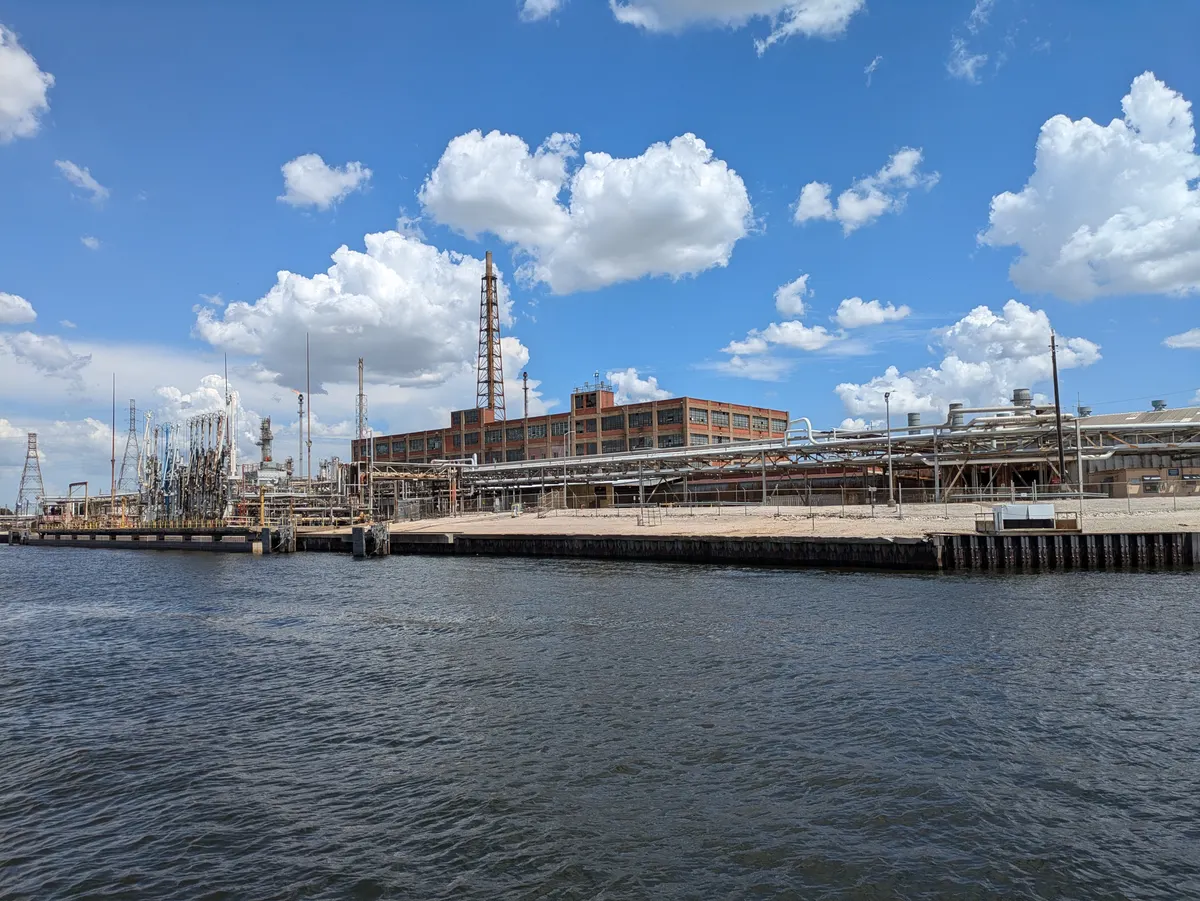
The $150 million figure, the 'millions of gallons per day' estimate and Wright's quote come from the Energy Department's Oct. 22 release; no projects or companies have been named. Trump's quote is from his Sioux City, Iowa, rally Thursday night as reported by UPI and Radio Iowa. Fuel prices are AAA national averages for Friday, Oct. 23, as reported by CBS News. Refining capacity figures are EIA's Jan. 1 operable capacity data; the gallons-to-barrels comparison is a US Brief calculation. Hero photo shows LyondellBasell's Houston refinery from the Houston Ship Channel in 2024 (file photo), one of the large plants Argus has listed as closed in the past two years; it has not been named as a recipient.
Like US Brief? You can support it with a tip.