
Medicare fraud rule targets $90 billion; UnitedHealth, Humana shares sink
A proposed CMS anti-fraud rule would let Medicare claw back about $9 billion a year from Medicare Advantage plans, sending UnitedHealth down 10.21% and Humana down 12.98% at Wednesday's close. CMS says the full rule would save nearly $90 billion over 10 years; insurers beat an earlier version of the audit rule in court.
AI-assisted · US Brief desk · Sources listed below
What happened
Health insurer stocks fell for a second day Wednesday after the Centers for Medicare & Medicaid Services proposed a sweeping anti-fraud rule that would let it claw back more money from Medicare Advantage plans. UnitedHealth closed down 10.21% at $349.91 and Humana closed down 12.98% at $385.78, according to Yahoo Finance and CNBC. Elevance fell 7.63%, Centene 7.03% and CVS Health 5.20%. Measured from Monday's close, before the proposal came out, UnitedHealth was down 15.1% over two sessions.
Why it matters
Medicare Advantage is the private-plan alternative to traditional Medicare, and UnitedHealth alone carries a 4.32% weight in the Dow, Yahoo Finance noted, so the selloff hit the broad market. If audits reach back to 2018, plans could owe back money they already booked as revenue, StreetInsider reported. Oppenheimer expects plans to price that cost into future bids, which is where seniors could eventually feel it. For taxpayers, the question is how much of the roughly $9 billion a year CMS actually recovers after the expected legal fight.
More context
The Dow closed down 561 points, or 1.11%, at 50,198.17, with UnitedHealth among its biggest drags, according to CNBC and Yahoo Finance. The S&P 500 closed down 0.23% and the Nasdaq closed up 0.42%, as Nvidia's slide after its earnings report also weighed on the market.
The rule: CMS calls it the Comprehensive Regulations to Uncover Suspicious Healthcare, or CRUSH. Released Monday, Nov. 16, it covers Medicare, Medicaid, CHIP and the Affordable Care Act marketplace. CMS estimates its quantified provisions would save nearly $90 billion in federal spending from 2027 through 2036, at a cost of about $378.5 million, according to the agency's fact sheet.
Why insurers are selling off: The part that matters most to investors is the Medicare Advantage audit program, known as RADV. Medicare pays private plans more for sicker members, based on diagnoses the plans report. The audits check a sample of medical records to see whether those diagnoses hold up. CMS proposes to apply each sample's error rate to a plan's entire contract, starting with payment year 2018, and to drop a "fee-for-service adjuster" that insurers say is needed to account for coding errors in traditional Medicare. CMS says this would let it collect about $9 billion per payment year, on average, in Medicare Advantage overpayments.
Other changes: Medicare Advantage and Part D plans would have to report suspected fraud to CMS. Today it is voluntary, and only 46% of plan contracts did so in 2025, the fact sheet says. Providers would have 30 days to report any enrollment change, CMS could bar providers whose owners can't be identified, and Marketplace agents with certain felony convictions could be shut out. The rule also adds protections for seniors against unsolicited texts and door-to-door pitches from medical supply sellers.
The administration's case: "President Trump directed us to stop fraud, waste, and abuse, and HHS is taking action to protect taxpayer dollars," HHS Secretary Robert F. Kennedy Jr. said. CMS Administrator Dr. Mehmet Oz pointed to "criminals... billing Medicare for nonexistent canes and wheelchairs" and "fraudulently enrolling healthy seniors in Medicare-funded hospice care." HHS says Medicare program-integrity savings rose 59% to a record $41.9 billion in fiscal 2025, from $26.3 billion in 2024.
The insurers' case: The industry has fought this audit method for years. When CMS first proposed dropping the adjuster in 2018, AHIP, the main insurer trade group, said the adjuster is "legally and actuarially required" and that removing it could cause "highly random and arbitrary results," Fierce Healthcare reported. In September 2025, Chief Judge Reed O'Connor of the Northern District of Texas threw out CMS's 2023 version of the rule in a suit brought by Humana, finding the agency had not followed proper notice-and-comment steps. The government's appeal is pending at the 5th Circuit.
What analysts say: Oppenheimer analysts wrote that CMS "will be subject to the same legal challenges that it faced in 2025," and that the larger collection estimate reflects broader auditing, with recoveries concentrated in 2028-2030. Even if the rule survives, they said, plans would likely build the cost into future bids, Yahoo Finance reported.
What the evidence shows: CMS estimated $23.9 billion in improper payments in Medicare Advantage (Part C) in fiscal 2026, Fierce Healthcare reported. CMS also says improper payments are not necessarily fraud; they include documentation and administrative errors.
What's still unknown: How much each insurer could owe. UnitedHealth has not sized its exposure, Wall Street Observer reported, citing Investing.com. Also unknown: whether the 5th Circuit rules before the rule is final, and what CMS changes after public comment. The proposal is set for formal publication in the Federal Register on Thursday, Nov. 19, and comments are due Jan. 19, 2027.
16 listed sources
- HHS press release, CMS CRUSH proposed rule aims to reap nearly $90 billion for taxpayers, Nov. 16, 2026 (primary document)
- CMS fact sheet, CRUSH proposed rule (CMS-6098-P), Nov. 16, 2026 (primary document)
- Federal Register public inspection copy of the proposed rule, 2026-23461 (primary document)
- Yahoo Finance (Grace O'Donnell), UnitedHealth and other insurance stocks drag down the Dow after CMS proposes new anti-fraud rule, Nov. 18, 2026
- CNBC, Stock market today: Live updates, Nov. 18, 2026
- Reuters (via MarketScreener), Stocks slip with Nvidia, dollar ticks higher, Nov. 18, 2026
- Wall Street Observer, CMS CRUSH rule sends UNH down 9.6%, Humana down 11%, Nov. 18, 2026
- StreetInsider, UnitedHealth stock continues lower amid federal audit proposal, Nov. 18, 2026
- Fierce Healthcare (Dave Muoio), CMS proposes sweeping Medicare integrity rule it says will save $90B, Nov. 17, 2026
- Fierce Healthcare, Proposed changes to Medicare Advantage audits could put insurers on the hook for billions, 2018
- Crowell & Moring, Court vacates CMS's 2023 final rule on RADV audits, Sept. 26, 2025
- Georgetown O'Neill Institute Health Care Litigation Tracker, Humana Inc. et al. v. Kennedy et al. (5th Cir. No. 25-11293)
- Yahoo Finance, UnitedHealth Group (UNH) quote, Nov. 18, 2026 close
- Yahoo Finance, Humana (HUM) quote, Nov. 18, 2026 close
- CNBC, UnitedHealth Group (UNH) quote, Nov. 18, 2026 close
- CNBC, Humana (HUM) quote, Nov. 18, 2026 close
References listed by US Brief; a source count is not a verification score.
Editorial sourcing notes
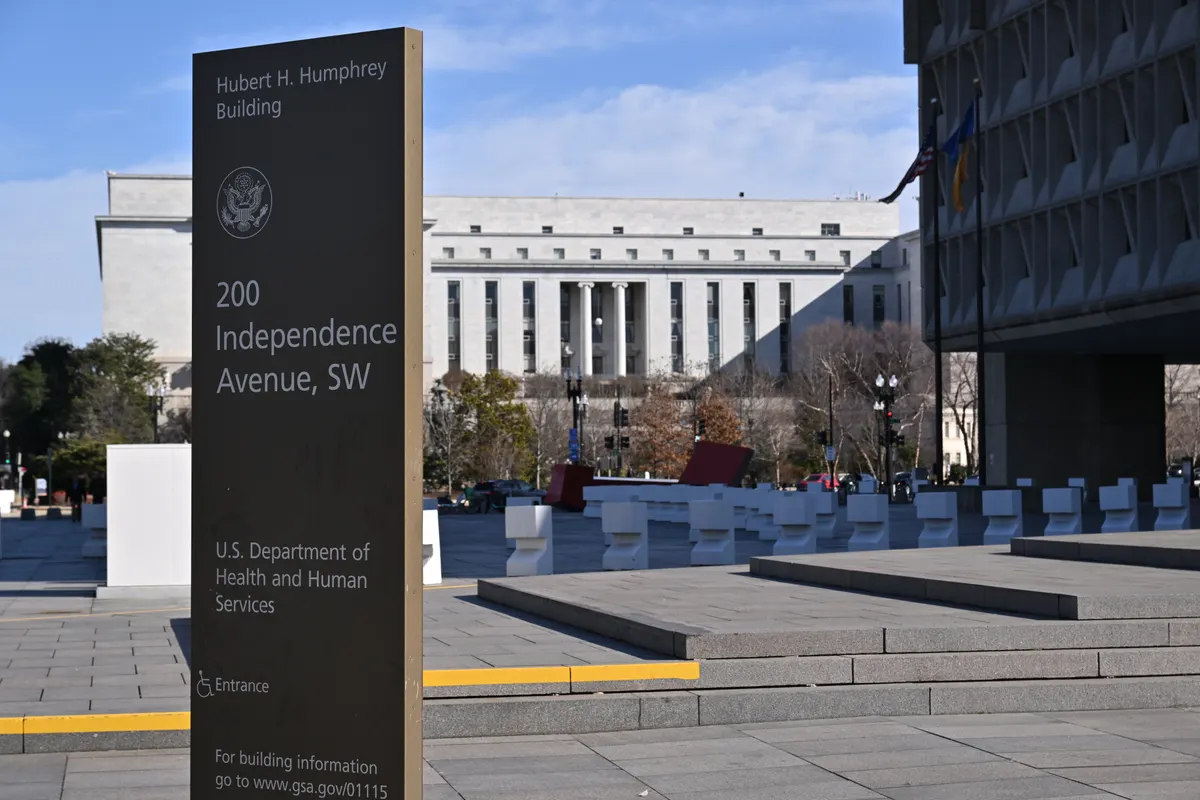
Stock moves are official Wednesday, Nov. 18 closing prices from Yahoo Finance and CNBC (UNH $349.91, down 10.21%; HUM $385.78, down 12.98%; ELV down 7.63%; CNC down 7.03%; CVS down 5.20%; Dow 50,198.17, down 561.25 points or 1.11%; S&P 500 down 0.23%; Nasdaq up 0.42%). UnitedHealth's two-session drop is measured from Monday's close of $412.02. The 2018 AHIP quote is the trade group's position on an earlier version of the audit change; US Brief found no new AHIP statement on this proposal. Photos are file images: the HHS headquarters sign (2025) and Dr. Oz's official portrait (2025). Rule details and savings estimates are CMS's own figures from its release and fact sheet.
Like US Brief? You can support it with a tip.